Phillip Danault appeared to score with about two seconds remaining in the third period to give the Canadiens a 5-4 lead, but the NHL's Situation Room initiated a goaltender interference review and nixed the goal. The game ultimately went to overtime, and the Senators won in a shootout.
The league explained postgame that Gallagher "impaired Ottawa goaltender Matt Murray's ability to play his position in the crease prior to the puck entering the net."
Gallagher disagreed with that assessment.
"I get knocked on my ass - I have time to reset, you can't tell me the goalie doesn't have time to reset," the Canadiens forward said, according to Sportsnet's Eric Engels.
Gallagher added that the NHL shows teams a video depicting goaltender interference every season, and he saw one in which Toronto Maple Leafs netminder Frederik Andersen got pushed but was able to recover, so the goal stood. Gallagher said the officials received the same video, and he wasn't happy about what he viewed as inconsistency in that regard.
The veteran forward believes video reviews have had a negative effect on the sport.
Tuesday's disallowed goal was the second controversial ruling impacting the Canadiens in a span of three days. On Saturday night, the NHL initially upheld a Montreal goal that cut the Maple Leafs' lead to 4-3 in the second period. However, the Leafs then challenged the play for goalie interference, and the goal was overturned. Toronto won that contest 5-3.
Canadiens head coach Claude Julien chose not to use a coach's challenge following the official review Tuesday night.
Pittsburgh Penguins forward Jason Zucker was forced out of Tuesday's 3-2 victory against the Washington Capitals after suffering an apparent leg injury late in the game.
Zucker had to be helped off the ice by trainers and didn't appear to be putting any pressure on his leg. Head coach Mike Sullivan didn't have an update on Zucker's status postgame, only saying he's being evaluated for a lower-body injury.
The 29-year-old has recorded four goals and three assists in 18 games this season.
Several of Artemi Panarin's former teammates in the KHL are questioning Andrei Nazarov's allegation that the New York Rangers star committed assault over nine years ago.
"(Panarin) was a great kid, I have nothing but nice things to say about him, so when I heard that, I was like, 'Oh, that doesn't sound like him,'" Jon Mirasty told the New York Post's Mollie Walker. "And I'm pretty sure I would have heard something like that, you know, being one of the older veteran players there.
"I never heard anything like that, so I was kind of blown away. I'm obviously not saying it didn't happen, but if I were to guess, (it didn't.) And why is it coming out 10 years later?"
Mirasty also said the allegation doesn't "add up to me."
Another one of Panarin's then-teammates, Kip Brennan, echoed that sentiment.
"I didn't know or hear that something like that ever happened," Brennan said. "He was a great guy, he was hilarious in the locker room. He always worked on his English with the North American guys and was a very talented young player."
Two other former teammates, who wish to stay anonymous, concurred with Mirasty and Brennan's assessments.
They all played with Panarin on KHL club Vityaz in 2011-12. Nazarov, a former NHLer who was the team's head coach at the time, recently told a Russian tabloid that Panarin got into a physical altercation with an 18-year-old woman during a road trip in Riga, Latvia, in December 2011.
Panarin took an indefinite leave from the Rangers on Monday, and the NHL club said the star forward "vehemently and unequivocally denies any and all allegations in this fabricated story." The club also called Nazarov's allegation "unfounded" and expressed its full support for the player.
Nazarov has been a vocal proponent of Russian President Vladimir Putin, and Panarin has expressed support for opposition leader Alexei Navalny, who was sentenced to three and a half years in prison earlier this month after being poisoned in August.
Panarin shared an Instagram post captioned "freedom for Navalny" in Russian in January, and Mirasty told Walker he's seen Panarin decry the Putin-led government.
Mike Babcock has received his fair share of criticism from around the NHL, but the bench boss doesn't necessarily believe it's totally warranted.
"I'm not a big media guy, following what's going on. You know if you're getting whacked or not," Babcock said on "The Rod Pedersen Show" Tuesday when asked what it's like getting criticized by the media for the last year and a half.
"I know who I am, I know what I've done. Some of this doesn't pass the smell test at all."
After spending 17 seasons in the NHL as a head coach, the Toronto Maple Leafs fired Babcock in 2019, and he hasn't returned behind the bench since.
The 57-year-old came under scrutiny after being dismissed for what was deemed by many as controversial coaching tactics. Babcock recently said he made a "major mistake" when he asked then-rookie Mitch Marner to rank himself and his teammates based on their work ethic during the 2016-17 season.
Babcock owns an impressive head-coaching resume featuring a Stanley Cup victory and two Olympic gold medals. He believes his experience and connections in the hockey world reflect his actual character.
"When you look at my career, I've always been hired by people that knew me - it's not like we had a Zoom meeting.
"When I went to Detroit, I had worked with Jim Nill and Ken Holland, we had shared a farm team together, they knew everything about me, so they knew me for four years. I worked with them for 10 years. Steve Yzerman played for me, he hired me to coach two Olympic teams, he worked with me for four years in the office. Then (Brendan Shanahan) hired me to coach (in Toronto).
"Something doesn't add up."
The Saskatoon native was recently named the new head coach of the University of Saskatchewan's men's hockey team.
The 26-year-old has registered three assists in 13 games this season while averaging 20:54 of ice time per contest. His underlying numbers are poor, as he's posted a Corsi for percentage of 47.1 and an expected goals for percentage of 48.6 at five-on-five, according to Natural Stat Trick.
Montour has one year left on his contract carrying a $3.85-million cap hit. He'll be an unrestricted free agent at season's end.
The Sabres acquired the right-handed blue-liner from the Anaheim Ducks in February 2019 in exchange for defenseman Brendan Guhle and a 2019 first-round pick (Brayden Tracey).
Many predicted the offseason addition of Taylor Hall would make the Buffalo Sabres an offensive juggernaut, but he and Jack Eichel have combined for just three goals on the campaign.
In five games since the team returned from its COVID-19 shutdown, Eichel has collected just two assists. Monday night's 3-2 loss to the New York Islanders was a particularly rough outing for the captain, as the Sabres generated just 27.3% of the shot attempts and 26% of the expected goals while Eichel was on the ice at five-on-five, according to Natural Stat Trick.
Head coach Ralph Krueger was asked postgame if Eichel was hurt.
"No. No, he's not," Krueger said, according to The Athletic's John Vogl. "For me, it's a confidence factor. He needs to stick with it and persevere."
Hall created more chances on Monday than Eichel, but he remains stymied with one goal on the campaign. Krueger believes Hall and Eichel need to work through their struggles and start carrying the offense.
"If you look at Taylor Hall today also, six shots on net, posts again," Krueger said. "They need to stick with it and they need to believe and work through this and then get our five-on-five game going on their backs."
The Sabres are also lacking contributions from Jeff Skinner, who has yet to score in 14 games. He was a healthy scratch on Monday.
Eichel, Skinner, and Hall make up 33.1% of the Sabres' salary cap, according to CapFriendly.
Buffalo is in last place in the East Division and ranks 28th in goals per game.
Brantt Myhres' eyes widen when he's asked about the shiny motocross bike in his living room.
"This is the fastest production dirt bike ever made," Myhres said during a recent Zoom call, moving his head away from the camera so his Kawasaki KX500 could fill up more screen space. "They stopped making it 18 years ago when the four strokes came out."
The 65-horsepower, neon-green bike isn't merely a toy for the former pro hockey badass. It's also a reminder of his childhood in Alberta - the good and the bad.
"When I was little, it was a way for me to escape from what was going on at the house," Myhres, 46, said. "I'd head out to the alley nearby and ride for hours on my dirt bike."
Todd Warshaw / Getty Images
Myhres is the author of a new book, "Pain Killer: A Memoir Of Big League Addiction." In 2006, the NHL handed him a lifetime ban after his fourth drug-related suspension. The autobiography chronicles his difficult upbringing with a distant father and an abusive stepfather, as well as a childhood encounter with a sexual predator he met through the Big Brothers Big Sisters program. It dives deep into the rise and fall of an NHL tough guy who not only went toe to toe with all-time heavyweights like Georges Laraque but also squandered millions of dollars while battling anxiety-induced addictions to alcohol and cocaine.
"This isn't about Brantt Myhres," he said of sharing his life's story. "Yeah, I wrote it, but at the end of the day this is way bigger than me. My hope isn't about book sales; I couldn't care less about that. I've got enough money. This is about the 15-year-old sending me a message, saying, maybe I saved his or her life or their parent's life.
"That, to me, is the juice. Nothing else."
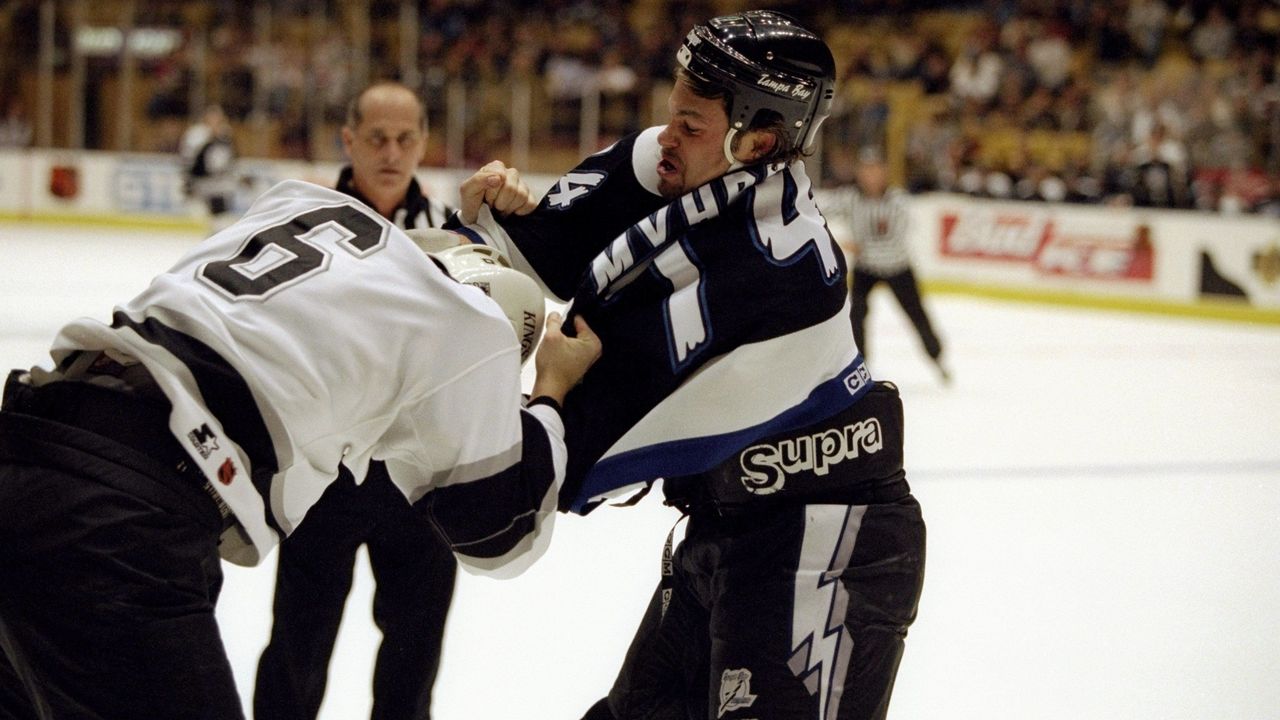
During a journeyman career stretching from 1993 to 2006 and featuring minor-league stops in the IHL, AHL, and EIHL, Myhres picked up six goals and two assists in 154 NHL games as a 6-foot-4, 220-pound winger. He fought 55 times, according to HockeyFights.com, racking up 687 career penalty minutes as a member of the Tampa Bay Lightning, Philadelphia Flyers, San Jose Sharks, Nashville Predators, Washington Capitals, and Boston Bruins.
Off the ice, alcohol became "more important than food." For years, Myhres says, he “couldn’t fathom not drinking again” as most social interactions turned into lengthy parties. Over time he even figured out how to temporarily hide his substance abuse from NHL officials, by either supplying fake urine samples or cozying up to the league’s testers.
"I was just loving it. I was a kid in a candy store," Myhres said of his ability to skirt the testing system. "But there's a line in the book that's never left me: The NHL told me, 'It's going to come to a point where we're not going to have to bust you. You're going to bust yourself.' And it's so true. I kept grabbing the rope and grabbing the rope, and then eventually I didn't have good urine. I busted myself at the end of the day."
Rock bottom arrived around 2:30 a.m. on Feb. 18, 2008. Myhres, recently retired after an unsuccessful half-season playing in England, was handcuffed in the snow outside of his sister's house. He had blacked out from drinking alcohol for the first time in his life.
"The stuff that I did during the blackout was very scary. I mean, having a knife out and having my sister by her throat … the kids were hiding in the closet upstairs," he said, relaying his sister's recollection. "When I got home that night I remember waking up and just hysterically crying for, I would say, a solid hour. Maybe an hour and a half."
With his daughter Chloe due to be born in five days, Myhres entered rehab for a fifth and final time. He spent six months as an inpatient and another two in an outpatient program.
"At that point I had no hope. I was completely broke financially, and spiritually, and physically. I was broke every which way you could be broke. I think that would have been the turning point," said Myhres, who last week celebrated 13 years of sobriety.
A Pichette / Getty Images
He started writing about his struggles in that Oregon treatment center. Originally, it was purely therapeutic, not meant for public consumption. But eventually his openness and willingness to attack his problems head-on led to a counseling position with the Los Angeles Kings in 2015. He worked as the club's player assistance director for three years.
Ex-Kings coach Darryl Sutter was instrumental in bringing Myhres into the organization. Sutter believed in him then and throughout his dizzying career. Myhres counts Sutter, who coached him in San Jose and became a father figure, and Dan Cronin, the director of the league's substance abuse program, as heroes of his story.
"Dan was a guy who called me on the morning of the 18th, and said, 'Hey, we heard what happened last night. Would you commit to long-term treatment?' I'm like, 'You guys are going to pay for treatment again?' I couldn't believe it," Myhres said. "And he said, 'Don't worry about anything. Just get yourself on a plane.' So I owe so much to the league and the NHLPA for not only investing in the treatment center, and all of that, but they also paid for me to go back to school. They gave me a monthly stipend through the emergency fund. They gave that to me for like four years, and I'm like, 'OK, I've been three years sober and they're still sending me $1,200 a month. Incredible.'"
Armed now with education in substance abuse and behavioral health from Calgary's Mount Royal University, as well as the practical experience from his time with the Kings, Myhres hopes to catch on with another NHL team. He doesn't see the downside in hiring an ex-player to help shepherd active players through issues relating to mental health, substance abuse, or both, like the Kings did with him and the Calgary Flames are doing with alumnus Brian McGrattan.
"I just don't understand," Myhres said of the lukewarm response from a group of 20 teams he's approached since parting ways with L.A. "When you're talking about additional support - they bring in all the nutritionists, health experts, sleep experts, and all of this - they don't really pay enough attention to the mental health side of it. The reality is, one or two guys are going to have issues on every team. That's a guarantee."
@brantt_myhres / Instagram
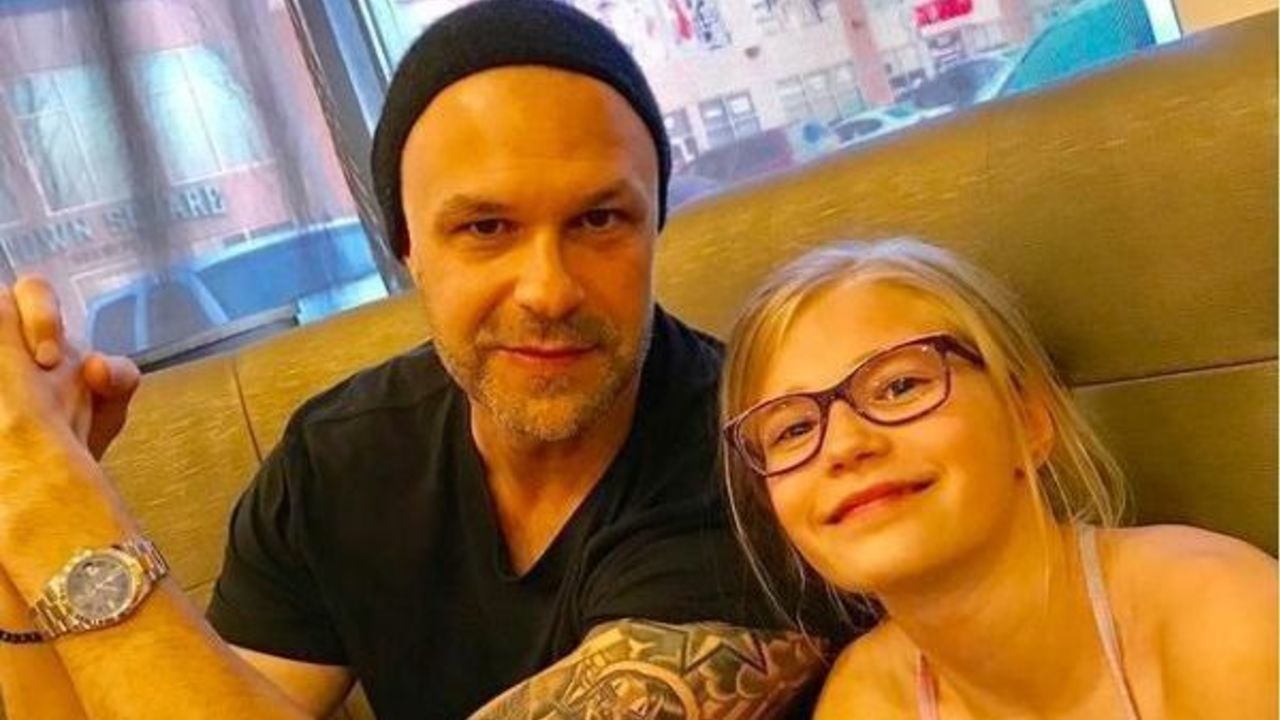
Ahead of the launch of "Pain Killer," Myhres felt compelled to tell Chloe - who turns 13 on Thursday - that the person portrayed in the first half of the book isn't the person he is today. Those nights of hot tubbing with strippers and brawling in bars are long gone.
ButMyhres is fully aware of just how powerful addiction can be.
"I've done a lot of work on myself the last 13 years. It's a daily thing for me," he said. "I never look at my sobriety and say I'm out of the woods. Because I'm not."
The dirt bike, which Myhres calls "the beast," is one of the ways he maintains his sobriety. He plans to visit a friend in British Columbia in April to test it out before the weather warms in his hometown of Edmonton.
"Me, with the need for adrenaline, I want the fastest thing that is made," he said with a giant smile. "If I go out on a dirt bike, great. That's OK with me."
John Matisz is theScore's national hockey writer. You can follow John on Twitter (@MatiszJohn) and contact him via email (john.matisz@thescore.com).
In the second edition of theScore's 2021 Calder Trophy Power Rankings, we feature three rookies new to the list, including one of last year's high-profile draftees.
Although postponements and small sample sizes have skewed some of the numbers, these five freshmen are worthy of recognition.
5. Pius Suter, Chicago Blackhawks
Dave Reginek / National Hockey League / Getty
GP
P
ATOI
xGF%
19
10
15:43
48.12
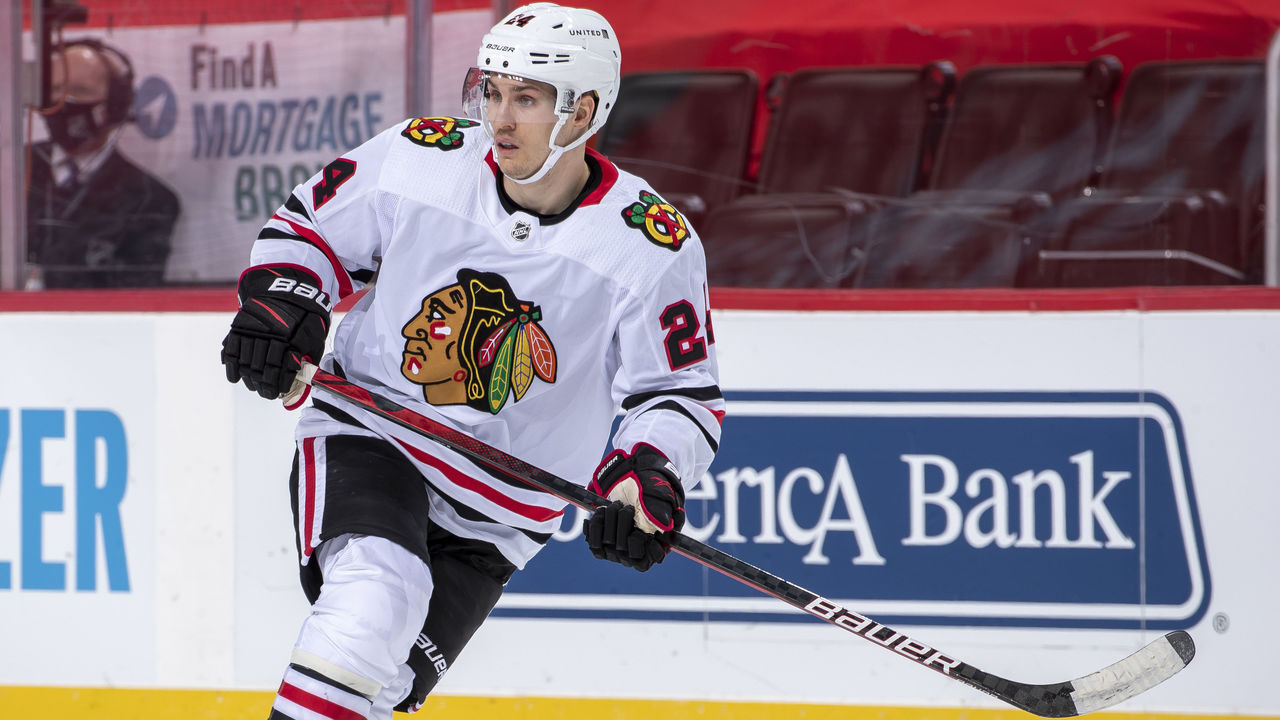
Suter has filled in admirably on the Blackhawks' top line after Jonathan Toews and Kirby Dach suffered injuries. The 24-year-old leads all rookies in goals (six) and ranks third in points. Suter's done the majority of his damage at even strength, too. He's already exceeded expectations as an unheralded signing out of Switzerland.
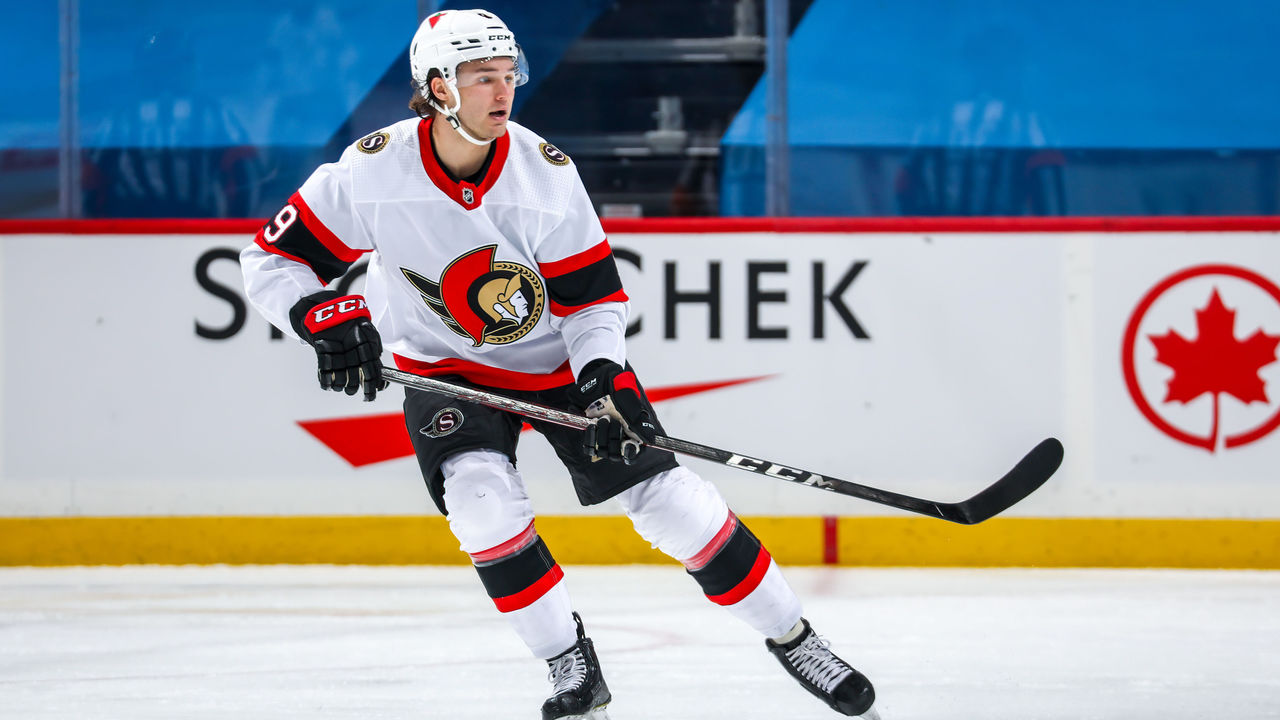
4. Josh Norris, Ottawa Senators
Jonathan Kozub / National Hockey League / Getty
GP
P
ATOI
xGF%
20
11
15:30
58.44
Norris has been a real bright spot in what's been a difficult season for the Senators. The 21-year-old pivot ranks second on the team in scoring and second among all rookies, though he's played more games than most of his peers. However, Norris' underlying numbers are perhaps the most impressive aspect of his debut campaign. His expected goal stats shine relative to his teammates, which is a great sign for a club in desperate need of depth down the middle of the ice.
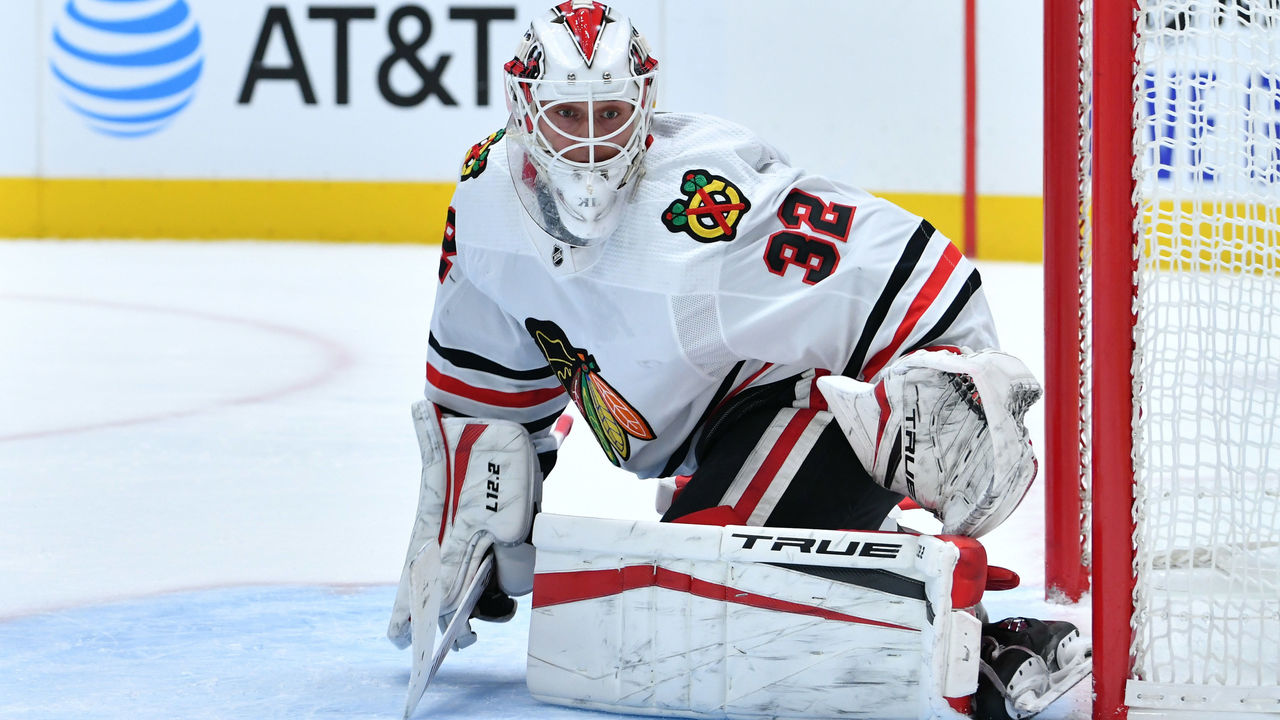
3. Kevin Lankinen, Chicago Blackhawks
Glenn James / National Hockey League / Getty
GP
W
Sv%
GAA
13
7
.927
2.42
Lankinen has come out of left field to change the entire outlook of the Blackhawks' season. Chicago was widely considered to be a lottery team thanks to injuries and uncertainty in goal, but the undrafted 25-year-old has thrust the club into playoff contention. Lankinen's save percentage through 13 games ranks fifth in the league, and he's tied for the lead among all goalies with nine goals saved above average.
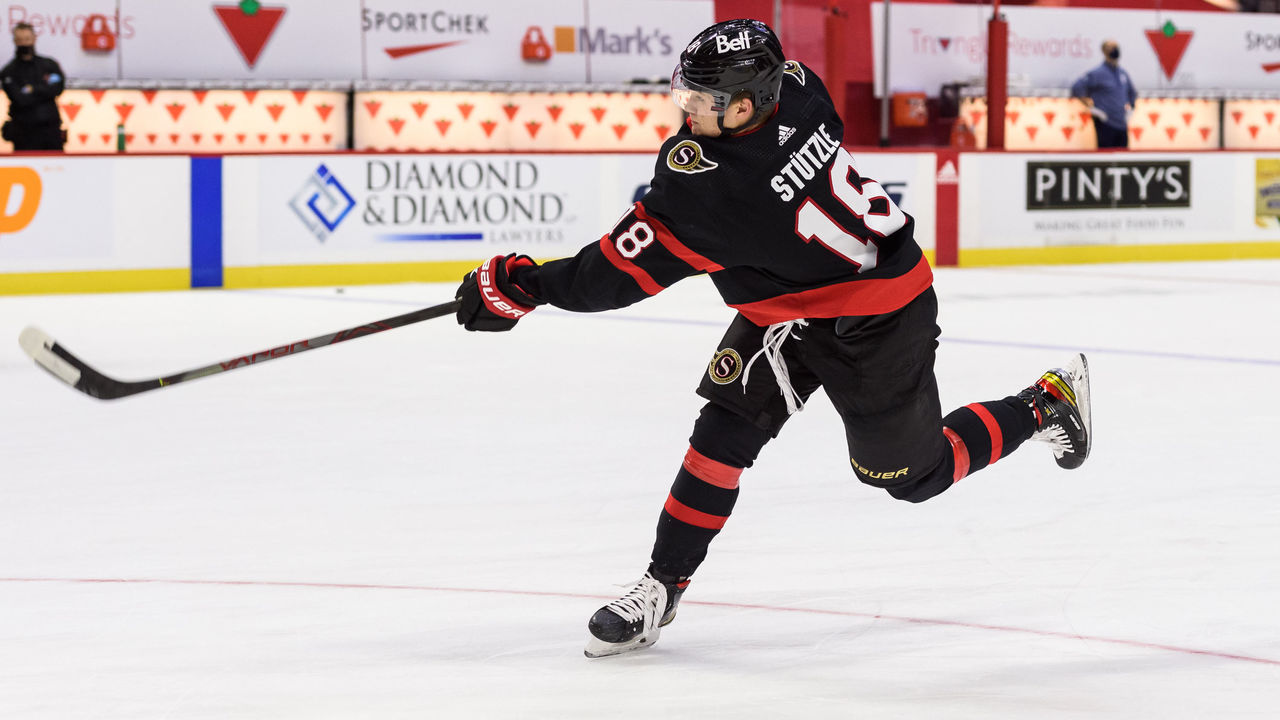
2. Tim Stutzle, Ottawa Senators
Icon Sportswire / Icon Sportswire / Getty
GP
P
ATOI
xGF%
17
9
15:35
40.21
Stutzle has made a charge up our rankings after missing the cut last month as he's more consistently showcasing his scintillating skill set. The 2020 third overall pick leads all rookies with seven points in February and appears to be getting more comfortable with life in the NHL. Stutzle is emerging as a stronger scoring threat with each passing game; he'll only see his point total climb as he's awarded more responsibility.
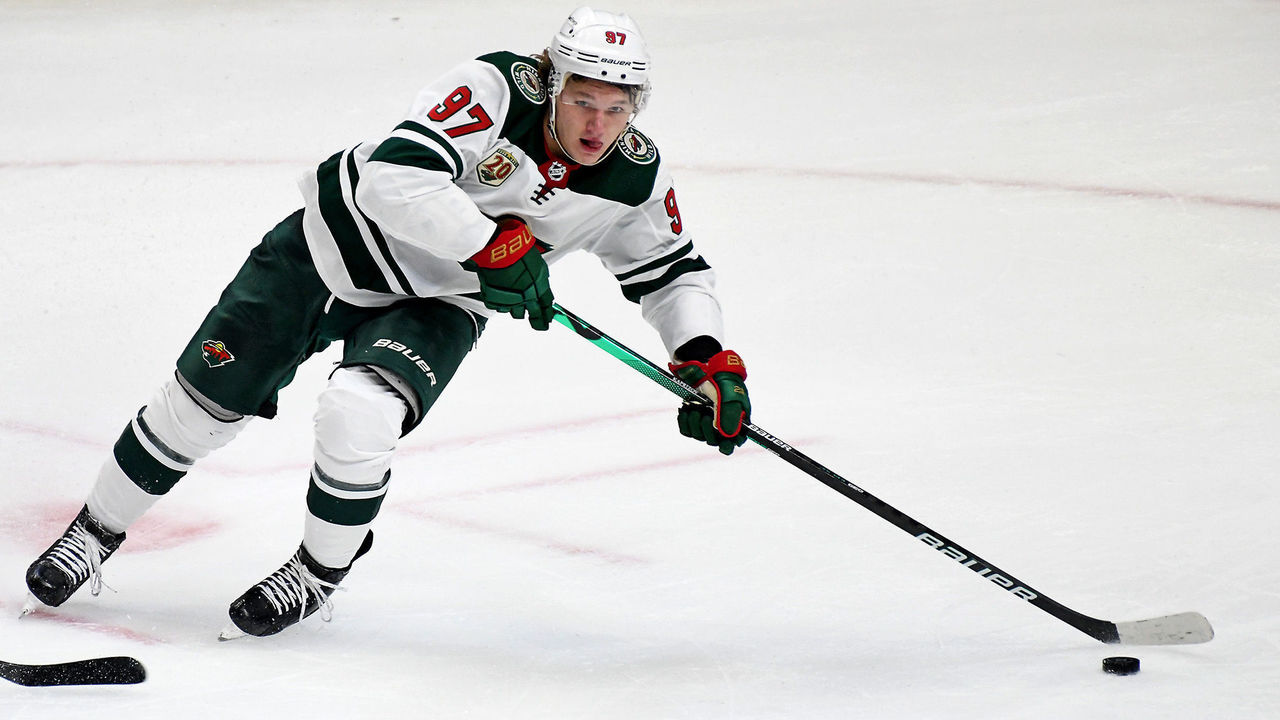
1. Kirill Kaprizov, Minnesota Wild
Icon Sportswire / Icon Sportswire / Getty
GP
P
ATOI
xGF%
15
13
18:11
48.3
The Wild have played only five games in February due to a COVID-19 outbreak, yet Kaprizov leads all rookies in scoring. The Russian winger also tops Minnesota in points, and he leads all first-year forwards in ice time. Not only has Kaprizov met expectations in his inaugural season on North American soil, but he's also proved to be the most dynamic first-year player in 2021 by a significant margin.